|
The maritime history of our family goes back to 1300 at least, mostly relating to trade, with Europe and the Americas. There have been some interesting stories during that time, some of which can horrify. Among them, is that of the Luxborough Galley. Slavery today in any form fills us with horror and disgust, but 250-300 years ago it was accepted as a way of life, for some. The Luxborough Galley was a fine new, fast ship. While trading officially to Spanish America, more particularly the British West Indies, it also carried slaves for the South Seas Company, one of two prominent English trading companies in the 18th century. The other, the East India Company survived longer, became powerful, with heavily armed ships for long voyages to the east, and eventually formed the Indian Navy. Family members served with both. | |||||||||
The Luxborough, 340 tons and 26 guns, was set up as a cargo vessel and slaver. Commanded by William Kellaway of Upwey in Dorset,
she sailed from the Downs for Guinea in West Africa on 21 October 1725, the first leg of a regular triangular trade route.
The ship seems to have gone further south to Cabinda and remained there for some time. While there Captain Kellaway was attacked
as a result of an affront to the African King by a white man. The cargo of Indian cottons and other goods was however exchanged for 600 slaves.
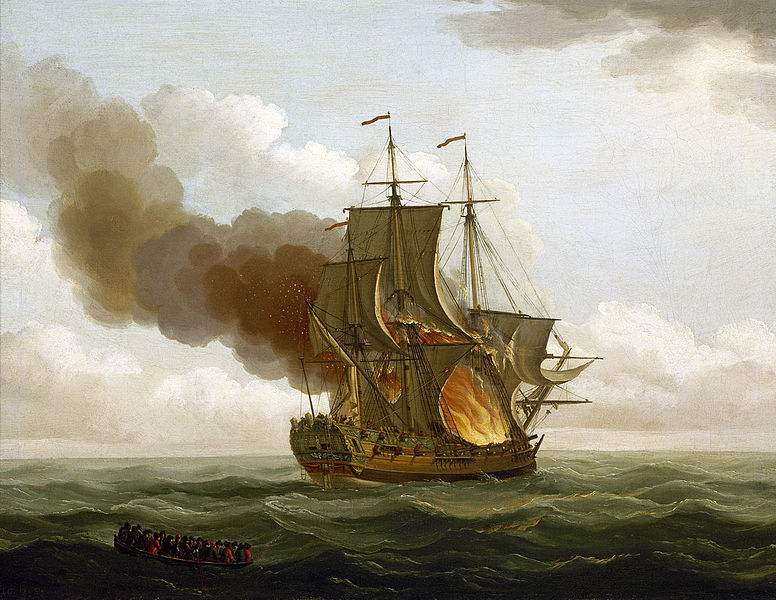
The number suggesting the Luxborough was a relatively large ship. Crossing the Atlantic on the second leg, 8 crew and 203 Africans died of smallpox, but the surviving Africans were delivered to Jamaica in October 1726, a year after the ship left England. Due to some political difficulties with Spain at the time, the ship was then to be taken up in the Royal Navy service of King George I, equipped with 34 guns and 80 men. However after the English Admiral arrived, a change of mind saw the men and cargo taken off. After surviving a severe hurricane at Jamaica, which destroyed many of the ships there, the Luxborough was eventually loaded with 90 hogsheads of sugar, 1000 gallons of rum, and 80 tons of other goods. As some small good fortune, the ship′s yawl, which had been driven a mile inland in the hurricane, had been brought back by the crew, and repaired. Following further repairs to the ship, she sailed on the final leg home, on 23 May 1727. The ship sailed from Kingston three days after the main Fleet but the Luxborough caught them the next day and sailed on, even leaving a man-o-war, HMS Winchelsea, behind. Off the coast of Newfoundland however, on 25 June 1727, it appears “two black boys”, who were sent below for rum, spilled some. They checked the spill with candles and the resulting fire soon ignited the 1000 gallons of rum and the ship was quickly engulfed, the gunpowder exploded and she was burnt out and sank. Only the overloaded, unprovisioned, 5 metre long ship′s yawl got away with 23 survivors. The other 16 passengers and crew died in the fire.
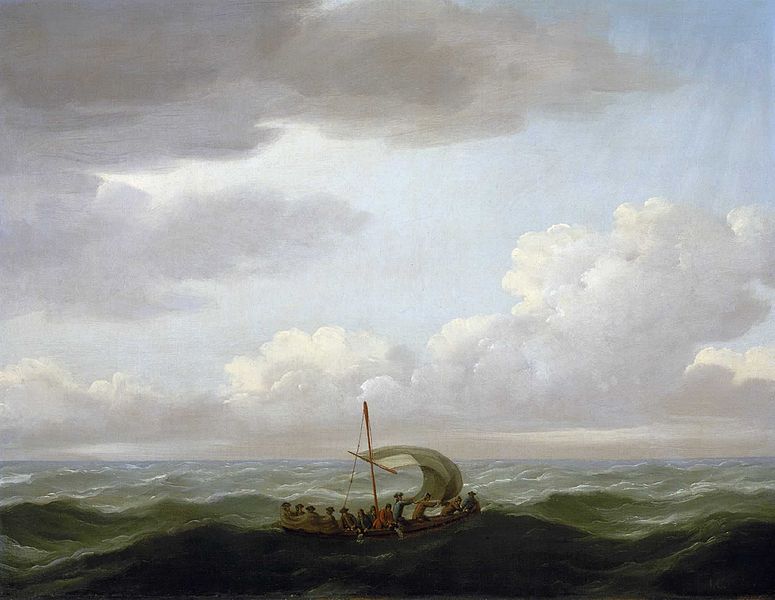
By the fifth day, the weather was stormy, there was no shelter or provisions, no food or water, and only three oars. A mast was made of one oar, a sail was made from their shirts. It was proposed to throw the two black boy culprits overboard, to lighten the load. The boys naturally objected, and although the captain disagreed, the crew agreed to cast lots instead. However before anyone was killed, one of the boys and another man died, presumably as a result of exposure. With no water or food, others died over the next nine days and the blood and some flesh of those who died, was, of necessity consumed with the assistance of the surviving ship′s surgeon. After two weeks of suffering, the surviving 7 were rescued by fishermen. They were taken to the closest land, St Lawrences Harbour, Newfoundland and were kindly treated by Captain Le Crass, of Guernsey, the admiral of the harbour. Captain Kellaway died the next day. Two of the seamen on the yawl also did not survive long, while two later lived into their 80s.
Only ship′s boy Robert Kellaway, mate William Boys, seaman George Mould, and surgeon Thomas Scrimsour, eventually reached home. One went south to the American Colonies. The story aroused a lot of interest at the time, and there was a series of paintings produced by John Cleveley the elder (held today at the National Maritime Museum Greenwich www.nmm.co.uk). There were three Kellaways on board, the captain William, the chief mate Ralph, and the ships boy, Robert. Ralph died in the fire, and William the day after reaching shore. Robert survived, later became mate of the East India Company ship Essex, and died in 1746 on the trade route to India. From their wills, William and Ralph Kellaway were brothers, and Robert a nephew. They were members of the Dorset family prominent at Upwey and Broadwey in the 17-1800s, and probably a branch of the Piddlehinton family, and the earlier Forston/Charminster family. Ralph, and William, were the sons of Henry Kellaway senior of Broadwey, but apparently left no descendants. It is not clear about Robert, but he may have been the son of Henry jun. William may have been in the Royal Navy earlier, being recorded on the TMS Boyne, when his brother Robert, of TMS Canterbury, died in 1697. He was 6th Mate on HMS Mary in 1717. There is no further detail of their service. (TMS relates to Their Majesties William and Mary.) From the Upwey and Broadwey Parish Registers, in 1733, William′s brother, brewer Henry Kellaway jun, had a Negro servant George Pugarron christened. Aged 18, George would have been about the same age as the two black boys at the time of the fire, when presumably “acquired” a year or so earlier. There were two Henry Kellaways there at the time, father and son. Clothier Henry Kellaway had been adjudged bankrupt in 1726, before the Luxborough had left Jamaica. While the Luxborough was at Kingston, on 28 March 1727, Captain Henry Kellaway, of the ship Lucy, was reported as arriving at Lisbon from Leghorn. This would have been presumably the Henry sen, possibly the Broadwey brewer Henry Kellaway. Perhaps on another voyage to the Indies, or more likely closer to home, to get wine. Lisbon/Portugal was famous for the Port Wine produced there by English families. Henry sen. died in 1743. He had a daughter Lucy. Brewer Henry Kellaway, presumably Henry Jun, was adjudged bankrupt in 1740, and had to sell his Broadwey Brewhouse the following year. Bankruptcy was not uncommon at the time. While fortunes could be made, or lost, in shipping. Two years before the Luxborough, on 17 June 1723, the Carlton, captain Thomas Kellaway, had sailed from London for Cabinda. Of 280 tons, 16 guns and a crew of 42, she was owned by the Royal African Company. The Carlton arrived at Jamaica on 21 May 1724, with about 396 out of the original 414 slaves – 265 men, 51 women, 61 boys, 19 girls – regarded a “good” survival rate. She returned to her home port on 2 Dec 1724. It seems probable that Thomas and William were cousins, and this was perhaps a precursor to the sailing of the Luxborough. Although there was no Thomas recorded in the families of the Luxborough, there were however Thomases at Piddlehinton, and a strong possibility is that he was the Thomas Kellaway of Bexington, who would be buried at Puncknowle in 1737. The Old Ship Inn at Upwey is thought to have belonged to the family, who retained an interest in the liquor trade into the 1800s. As Church Wardens they supplied wine to the Church at Broadwey. Brewer William Henry Farwell Kellaway the grandson of Henry jun, later moved to Norton sub Hamdon, in Somerset. There was also a “Farmer” William Kellaway living at Upwey in 1736. The “Farmer” title presumably being used to differentiate him from “Commander” William. It is now evident he was a cousin of the other William, and also of Thomas Kellaway jun. of Bexington nearby, who was buried at Portesham in 1776. Apart from the horror of the slave trade, and the subsequent ship burning and the cannibalism, it is interesting that the seamen even considered the lives of the boys. Possibly it was because not all Africans were considered as of the lowest social level or that they were only boys. Africans had lived in England for many years, and their lives were not those of the slaves in the plantations. It was of course also fairly common to transport English “miscreants” to work in plantations in America and the Indies, including some of our own kin. Englishmen would not have known much of the slave trade first hand, unless they had been to the colonies because it was the second leg of a trading voyage, but by 1800 new humanitarian attitudes stopped the sea trade, and forced abolition in Britain and her colonies. Warwick Kellaway 20 Oct 05 Updated April 2014 Two Newspaper accounts of the events can be found HERE.
The Captain died a few hours after he got on shore. * Evander Mackevoy was an High-lander, and, by trade, a taylor. He was the man who killed Blackbeard, the pirate; and had two large cuts on his head, which he received from Blackbeard, in fighting with him, hand to hand, on the sloop′s deck. Taken from the account of William Boys. | ||||||||||